Deep Progressive House — Melodic, Deep & Progressive

TL;DR
Deep progressive house sits where melodic deep house and progressive house meet: slower tempos, warm low end, long builds and emotional hooks. This listener’s guide explains the style, how it differs from deep house and melodic techno, where to find mixes, radio and playlists, and how to build a flow for home listening or a late drive.
What is deep progressive house?
Deep progressive house is a listener-friendly blend of melodic deep house and progressive house: mid-tempo grooves, warm bass, and long, evolving sections that favor mood over drops. It is not a strict, formal genre but a coloration within melodic electronic music. You’ll recognize it by tempo around the low-120s BPM, an atmosphere that feels unhurried yet focused, and arrangements that develop over 6–9 minutes rather than chasing quick hooks. In short, it’s progressive deep house shaped for immersion.
Key traits at a glance:
- Tempo: typically 120–124 BPM (steady, not rushed)
- Atmosphere: lush pads, reverb-dusted accents, and patient builds
- Arrangement: fewer hard breaks, more subtle lifts and releases
How deep progressive developed: origins and context
Brief history and origins: deep house and progressive house began crossing paths in clubs and on radio from the 1990s through the 2010s. Deep house brought the intimate bass and head-nodding swing; progressive house contributed the long-form development and storytelling arcs. Across the 2000s–2010s, DJs and labels explored this shared middle ground, especially as melodic deep house gained popularity.
In the streaming era, playlists influence how we label what we hear. Curators and algorithmic lists began grouping tracks by mood and energy—“deep house progressive,” “deep house melodic,” “deep house progressive house,” and “progressive deep house music”—which trained listeners to expect a certain vibe under the deep progressive house umbrella. The term now describes how a track feels and flows as much as where it came from.
Sonic ingredients: what this music sounds like
The core palette of deep and progressive house music leans on bass weight, smooth percussion, patient pads, and restrained but emotional melodies. In a deep melodic house context, you’ll hear warmth in the low end, shimmer in the highs, and a careful use of space.
Bass, groove and tempo
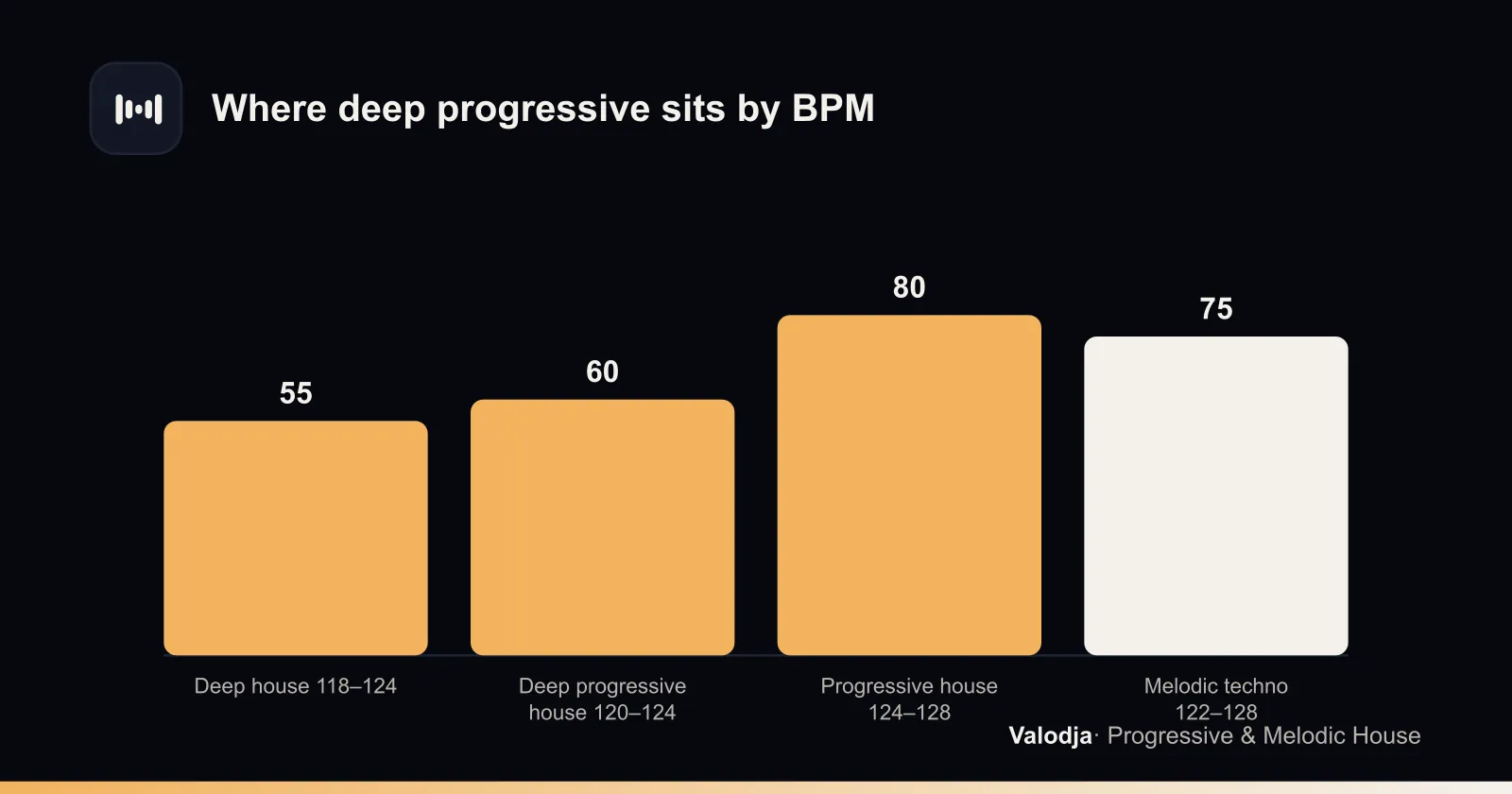
Tempo and BPM: deep progressive often sits at 120–124 BPM. That range is slower than peak-time progressive house and a touch firmer than very slow deep tracks. The bass line is typically warm and rounded—more sustained than staccato—gluing the kick and lower mids together. The groove emphasizes forward motion without sharp accents; it’s designed for longer blending and a calmer mindset.
Why this matters: a slightly slower tempo lets melodies breathe, and the groove feels grounded rather than urgent. In my DJ sets, I favor this tempo window to create an energy curve that starts intimate, opens up across 30–45 minutes, then gently settles.
Atmosphere, pads and long-form arrangements
Pads and ambience: expect wide pads and airy textures with tasteful reverb, sometimes sidechained to the kick for gentle movement. Long builds and evolving arrangements replace sudden drops; transitions often arrive as new layers, filtered motifs, or subtle percussion changes. This is why many tracks feel like a journey rather than verse/chorus repetition.
Use of space: production leaves headroom for late-night or drive-time listening. Elements are placed to let the low end speak while higher melodic lines come and go, keeping the mind engaged without fatigue.
Vocals, emotion and song structure
Vocal progressive deep house uses the voice for emotional color and hooks but not always as a pop centerpiece. You might hear processed vocals as short phrases, breathy harmonies, or a single evocative line looping across a build. Full verses and choruses appear too, but the arrangement still respects the long-form flow. Depending on the track, vocals can be intimate (a whispery lead), processed (pitched or layered for texture), or featured as a standout top line.
Emotion over showmanship: many deep progressive house songs prioritize a steady mood and a memorable motif instead of big-brake drops. Even in more dramatic cuts, the payoff is textural and melodic rather than aggressive.
How deep progressive differs from related styles
Here’s a quick compare across adjacent styles. The differences are about tempo, energy, structure, and sound design, with deep house vs progressive house providing the outer markers. Deep progressive lives in between, with a melodic house sensibility and a calmer pulse than mainstage prog, while stopping short of the tech-driven weight of melodic techno.
Comparison table (differences at a glance):
| Style | Tempo (BPM) | Energy & Groove | Structure | Mood/Texture | Good for |
|---|---|---|---|---|---|
| Deep house | 118–124 | Warm, swingy, intimate | Shorter phrases, loops | Spacey, soulful | Lounges, early sets |
| Deep progressive house | 120–124 | Solid, flowing, patient | Long builds, subtle lifts | Lush pads, emotional hooks | Drives, sunsets, focus |
| Progressive house (peak-time) | 124–128 | Bigger, more assertive | Epic builds/breaks | Polished, layered | Main rooms, late peak |
| Melodic house | 120–126 | Melodic-first, friendly | Balanced builds/drops | Tuneful, bright | Daytime sets, mixed moods |
| Melodic techno | 122–128 | Tension, hypnotic pulse | Long arcs, fewer vocals | Darker synth weight | Late nights, warehouses |
Note: for deeper detail, see our related guides on progressive house vs melodic techno and melodic house for deep work (no links here; use site navigation).
Where to listen: mixes, radio shows, playlists and continuous sets
A practical map for finding deep progressive house music, whether you want a quick tracklist or a two-hour immersion.
- Spotify: follow curated lists for “deep progressive house mix” flavors and steady updates. Save standouts to your own library.
- YouTube: great for a deep progressive house set (DJ continuous mix) with full-length journeys.
- SoundCloud: a hub for long uploads and repost chains that surface fresh names.
- Online radio: DI.FM-style channels host deep progressive house radio streams around the clock.
Search tips (exact phrases to try):
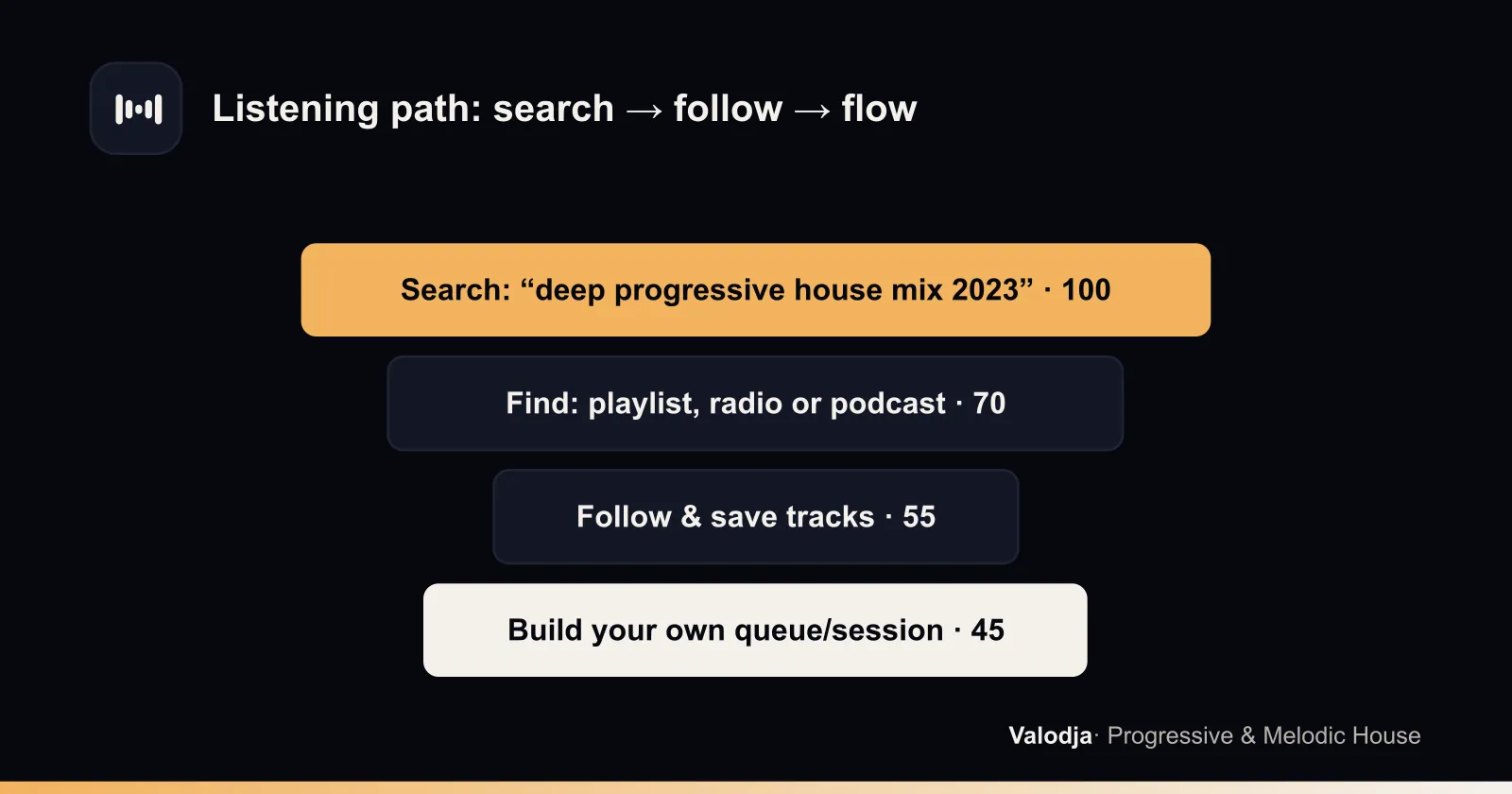
- “deep progressive house mix” + year, e.g., “deep progressive house 2021”, “deep progressive house 2022”, “melodic deep house mix 2023”
- “deep dark progressive house” if you want a moodier edge
- “deep sunset house and progressive podcast” for mellow, scenic episodes
- Add “tracklist” or “set (dj continuous mix)” when you want timestamps
Streaming playlists vs continuous DJ mixes
Playlists are best when you want variety and quick saves; a continuous mix is better for immersion and smooth transitions. For commutes or study, a focused playlist keeps the mood consistent while letting you skip. For a full evening, a continuous mix (or podcast episode) creates a start-to-finish arc without interruptions.
Practical tips:
- Use playlists for discovery, then queue a continuous mix for flow.
- Download for offline if you’re flying or on a long drive.
- Create your own queue: 60–120 minutes, ordered by energy and key.
Radio shows, podcasts and the ‘sunset house’ vibe
Many shows curate deep and progressive house music specifically for drives and sunsets. Look for “sunset house” descriptors or the exact phrase “deep sunset house and progressive podcast.” Episodes often clock in at 60–120 minutes, blending instrumentals with occasional vocals to support an unbroken mood.
Recommended mixes, playlists and entry tracks
Below is a starter pack—continuous mixes and sets, Spotify playlist angles, and a dozen representative entries. Use the embedded Spotify playlists on this page (late-drive, melodic-house-for-focus, slow-mornings) to jump right in.
Continuous mixes and sets (YouTube/SoundCloud styles):
- Seasonal melodic deep house and progressive deep house mixes from label-focused channels (long-form, timestamped)
- Anjunadeep Edition–style episodes (deep melodic house journeys; guest mixes from touring DJs)
- Lane 8–style seasonal mixtapes (patient builds; home and drive listening)
- Eelke Kleijn–type DAYS like NIGHTS episodes (cinematic, evolving)
- Hernán Cattáneo–type Resident episodes (classic progressive storytelling)
- DI.FM-style deep progressive house radio recordings (various hosts)
Spotify playlist directions to try:
- Valodja: late-drive (steady 120–124 BPM; moody night energy)
- Valodja: melodic-house-for-focus (calm, instrumental-leaning melodic deep house)
- Valodja: slow-mornings (soft-open sunrise energy)
- Official and curated “deep progressive house mix” lists for weekly discovery
Representative tracks (a listener-friendly on-ramp):
- Lane 8 — Atlas
- Yotto — Kantsu
- Ben Böhmer — Beyond Beliefs
- Luttrell — Intergalactic Plastic
- Tinlicker & Helsloot — Because You Move Me
- Marsh — Come Together
- Guy J — Fixation
- Eelke Kleijn — Mistakes I’ve Made
- Cubicolor — Dead End Thrills
- Nils Hoffmann — Breathing (feat. Malou)
Note: track availability varies by region. Use radio shows or continuous mixes if a track is geo-restricted.
How to build a deep progressive listening session
A deep progressive listening session flows like a composed scene: start grounded, bloom in the middle, land gently. For home listening, aim for 60–90 minutes; for a late drive, 75–120 minutes. Keep tempos within a narrow band and let energy rise across 3–5 sections.
My practical outline (from DJ practice):
- Track order: begin with deeper, more atmospheric cuts; move into melodic highlights; close with fewer vocals and wider pads.
- Energy curve: up in thirds—30% intro (settle), 50% main arc (lift), 20% outro (exhale).
- Mixing tips: keep neighboring tracks within 2–3 BPM; use compatible keys to avoid clashes; layer pads and arps to bridge sections.
- Home listening: set master volume so the kick is firm but the highs don’t fatigue. If you’re talking or working, roll back 2–3 dB.
Session blueprints (print-friendly):
| Session | Length | Tempo window | Energy curve | Vocals usage | Key flow |
|---|---|---|---|---|---|
| Slow Morning | 45–60 min | 120–122 BPM | Gentle rise to mid, soft landing | Light, processed vocals max | Neighboring keys (e.g., 8A→9A→10A) |
| Sunset Drive | 70–90 min | 121–123 BPM | Steady growth, one late peak | 2–3 vocal features, rest instrumental | Circle of fifths, avoid big jumps |
| Late Session | 90–120 min | 122–124 BPM | Long mid arc, smooth fade | Sparse vocals; darker midsection | Maintain key center, drift 2–3 semitones max |
Downloadables: this guide includes a PDF template with three ready-made sessions and a Mix blueprint (tracklist XLSX) for quick editing. If you see the download buttons, grab them and tweak the slots to taste.
Finding new releases and staying up to date
Use a blend of algorithmic and human sources so you discover without losing quality.
Actionable tactics:
- Follow playlists: add a few stable “deep progressive house music” lists and rotate one experimental list each month.
- Label channels: follow labels that consistently release progressive deep house and deep melodic house; save their new releases weekly.
- SoundCloud: follow artists plus a handful of curators; watch repost chains to uncover adjacent names.
- Radio shows and podcasts: subscribe to 2–3 long-form shows for continuous discovery while you drive or work.
- Algorithm control: when you find a standout, save it and play it through—this trains your recommendations toward progressive deep house music.
- Seasonal refresh: redo your “melodic deep house” and “progressive deep house” favorites each quarter to keep the feed fresh.
Conclusion and next steps (follow playlists and artist)
Deep progressive house rewards patient listening: warm low end, evolving melodies, and long arcs that fit home listening, late drives, and focused work. To stay in the flow, follow the embedded Valodja playlists here—late-drive, melodic-house-for-focus, and slow-mornings—and follow on Spotify to catch new releases and mixes. For related guides, explore our comparisons of progressive house vs melodic techno and our melodic house for deep work notes.
— Notes on experience: I DJ and produce melodic/progressive/deep sets. The session structures above mirror the sequencing I use in continuous mixes: narrow tempo bands, patient builds, and key-aware transitions aligned to the energy curve.
FAQ
- What are the key differences between deep house and progressive house?
- Deep house is typically slower and warmer, with intimate bass and space; progressive house is usually a bit faster with energy that rises across long sections. Deep progressive sits in between, blending deep’s atmosphere with progressive build-and-release.
- What does the term 'deep house' mean?
- Deep house is a house substyle focused on rich, warm bass, atmosphere and often soul or jazz influences. The term varies by scene and overlaps with melodic deep sounds in modern playlists.
- Where can I find deep progressive house mixes and radio shows?
- Search Spotify playlists, YouTube mixes, SoundCloud sets and niche online-radio channels (DI.FM-style). Try queries like “deep progressive house mix 2022”, “melodic deep house mix 2023” and “deep progressive house radio.”
- How is vocal progressive deep house different from instrumental deep progressive tracks?
- Vocal progressive deep house centers on a clear hook and emotion and may be shorter. Instrumental deep progressive favors space, evolving arrangements and longer transitions.
- Can deep progressive house be used in a DJ continuous set?
- Yes. The style’s steady tempos and long transitions make it ideal for a continuous DJ set. One tip: keep adjacent tracks within 2–3 BPM and compatible keys for smooth blends.