Melodic House BPM Range: Tempo Guide & Typical BPM

TL;DR
Most listeners will find the melodic house BPM range lands most often around 110–125 BPM, with overlap into the 120–128 BPM band at the dancefloor edge. That spread keeps melodies spacious but still mixable. Below, you’ll get an at-a-glance answer, comparisons with melodic techno and progressive house, practical DJ and production tips, and reliable ways to find playlists by tempo.
Melodic house has a flexible feel, but people still ask a precise question: what’s the melodic house bpm range? Below is a clear, listener‑first answer, then deeper context you can use to pick playlists, understand related genres, and enjoy smoother DJ sets.
Quick answer: typical melodic house BPM range
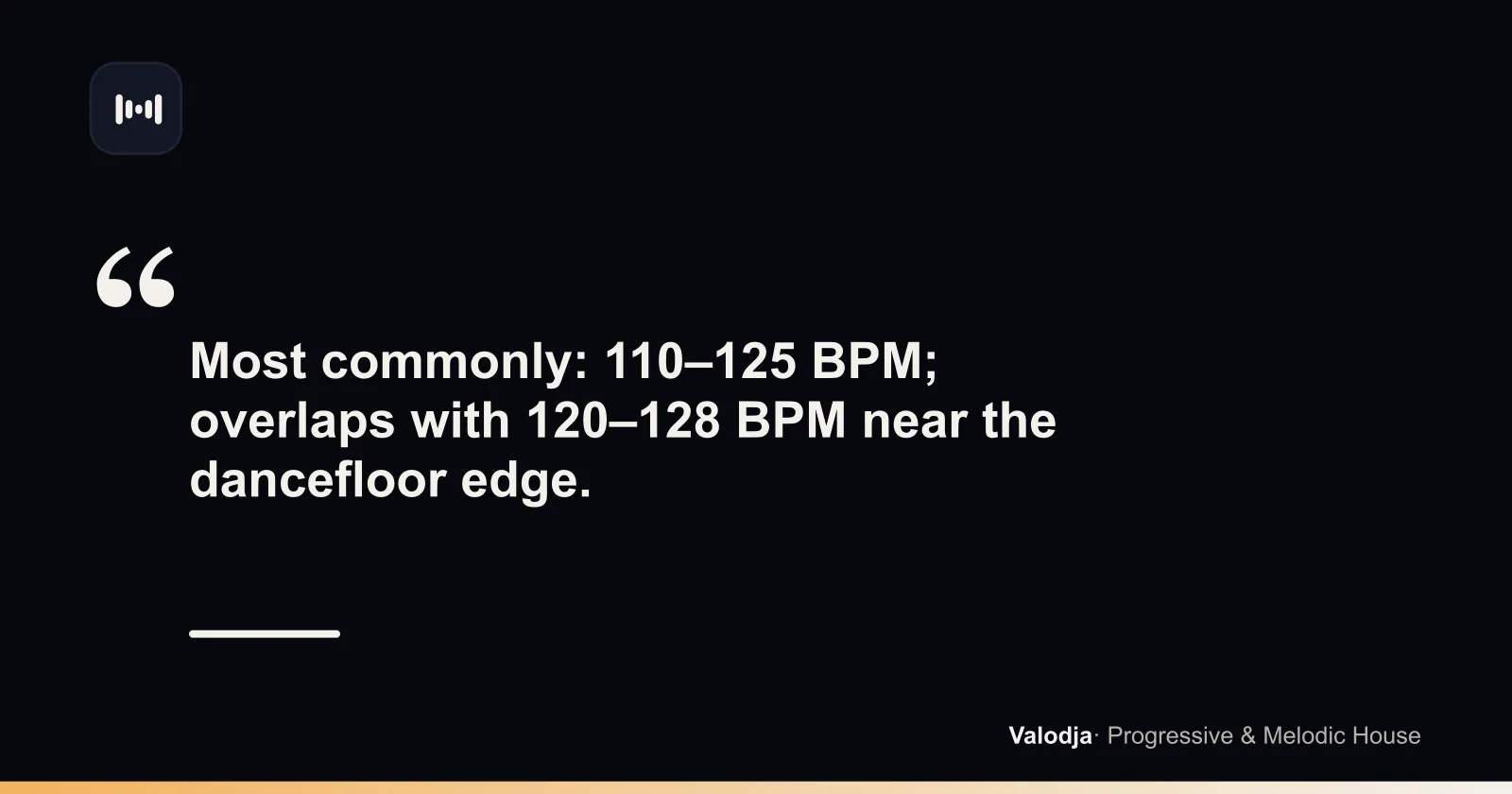
Most commonly, the melodic house bpm range sits around 110–125 BPM. That is the typical BPM band listeners and DJs encounter day to day. There is also meaningful overlap with 120–128 BPM, especially for tracks that lean more dancefloor or progressive. These are guidelines, not hard borders, and styles bleed into each other.
If you want a single phrase to remember: typical BPM for melodic house = 110–125 BPM, with overlap into 120–128 BPM on the higher‑energy edge. This melodic house typical bpm range keeps melodies expressive while remaining easy to mix. When you verify a specific number for a track or playlist, do a quick source check: Mixgraph, Spotify playlists, label pages, and your own ears.
Downloadables: a compact Melodic House Tempo Cheat Sheet (PDF) and a Tempo quick reference (XLSX) are provided on this page for offline use.
What melodic house tempo actually means
Tempo is the speed of the music; BPM stands for beats per minute and counts how many quarter‑note beats happen in one minute. For listeners, BPM shapes energy: higher numbers usually feel more urgent; lower numbers feel more relaxed. For DJs, BPM is a practical coordinate that determines how easily tracks align on the grid.
Two extra concepts explain why a number isn’t the whole story:
- Half-time feel: a 120 BPM track can feel like 60 BPM if the drums and bass hit every other beat. That gives a laid‑back sensation even at a nominally brisk tempo.
- Double-time: the reverse effect, where a 110–116 BPM track can feel excitable if hi‑hats, arps, or percussion pattern in double‑time against the grid.
Perception matters. A song at 118 BPM with long pads and spacious drums can feel calmer than a 112 BPM tune with busy percussion. That’s why we talk about typical ranges and listener expectations, not fixed rules.
Typical BPM ranges by sub-style and listener expectations
Use these ranges as orientation, not absolute laws. They reflect what listeners tend to expect inside melodic house’s core and its edges.
- Chill/organic melodic house: chill melodic house 110-116 BPM. Expect acoustic textures, organic percussion, and slower‑moving melodies that feel intimate or late‑night. Listener expectations: background‑friendly, warm, and steady. This zone suits yoga, reading, and relaxed drives.
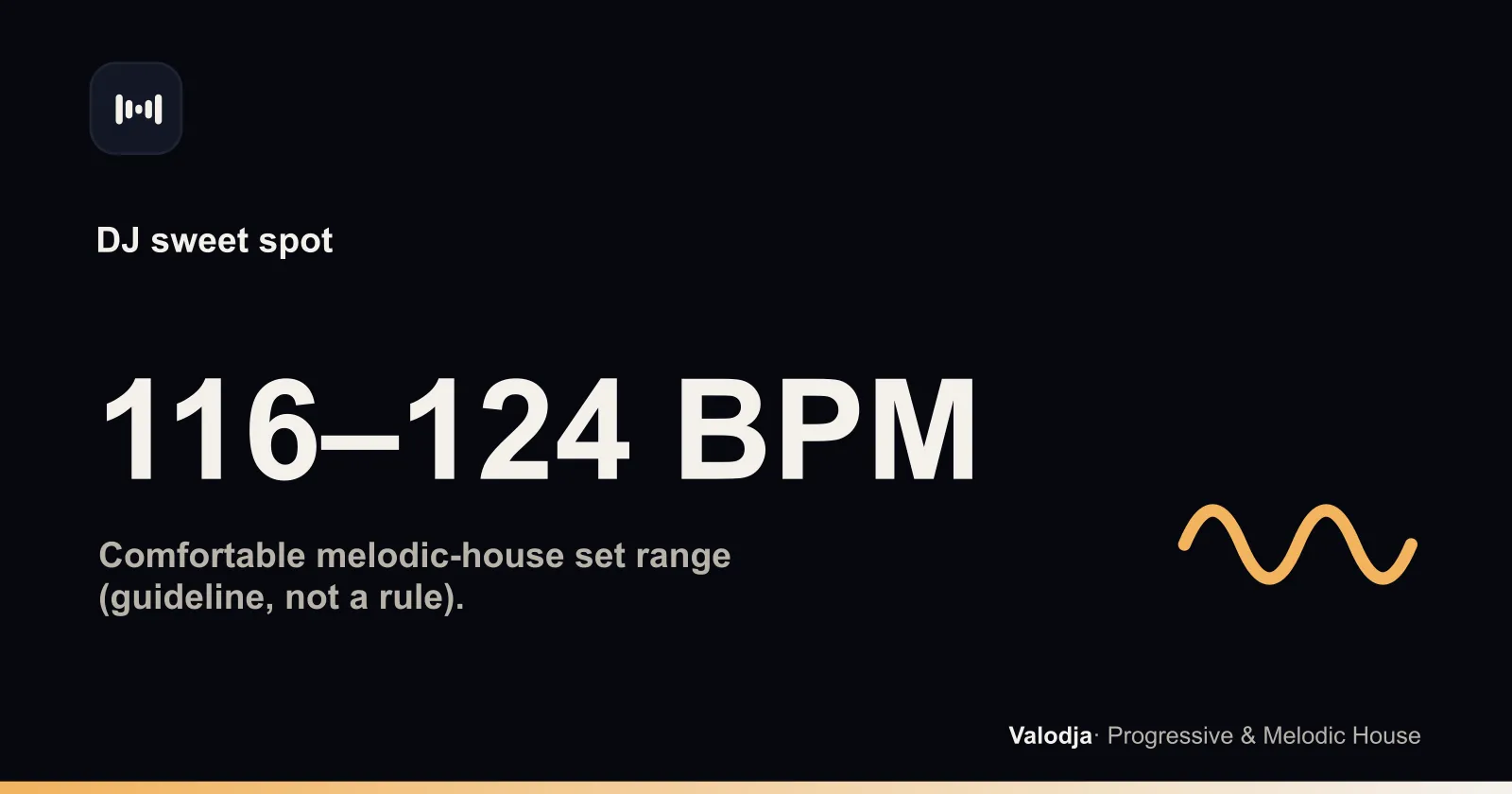
- Core melodic house: core melodic house 116-124 BPM. This is the center of gravity for many modern melodic house tracks—still emotional and melodic, but with a clean pulse for casual dancing. Listener expectations: flow‑state listening, working, light movement.
- Dancefloor/progressive overlap: dancefloor 122-128 BPM. Here, the genre rubs shoulders with progressive house and melodic techno. Expect tighter grooves, punchier drums, and arrangements that build for club moments. Listener expectations: focused movement, mid‑set energy, and peaks.
Orientation not absolute: producers and DJs frequently cross these boundaries on purpose. Tempos shift inside sets, and a single artist release can include both a relaxed 112 BPM original and a 124 BPM club mix.
Tempo distribution and measured data — how to present numbers responsibly
If you want to quantify the landscape, do it transparently. Use a clear distribution method and show how you measured. Good sources and tools include Mixgraph, Spotify playlists with visible tempo ranges, label catalogs, and your own author’s dataset (if any). If you state numbers, publish your methodology alongside them.
Responsible workflow for listeners, curators, and DJs:
- Define your sample. Decide which tracks and time window you’ll include (for example, a label’s 2021–2025 releases tagged as melodic house, or a specific playlist updated weekly). Note the sample size.
- Identify your measurement tool. You can rely on platform tempo data, use your DJ software, or verify in a DAW. If you average or smooth out tempos, say exactly how.
- Bucket your tempos. Create tempo buckets so readers can see the shape of the catalog at a glance.
- Publish summary stats. Median, interquartile range (IQR), and mode give a clearer picture than a single “average.”
- Document caveats. Tagging can be messy, and crossover tracks may skew toward the higher buckets.
Illustrative table structure for reporting your findings (template; fill with your dataset and notes):
| Tempo bucket (BPM) | What typically lands here | Example listening use | Notes on selection/method |
|---|---|---|---|
| 100–110 | Warm‑up outliers, organic downtempo crossovers | Gentle mornings, pre‑set | Define how you handled borderline downtempo |
| 111–115 | Chill/organic center | Reading, late‑night drives | Note any retimed edits or live versions |
| 116–120 | Core lower‑mid | Work focus, early club sets | Show if you included radio edits |
| 121–125 | Core upper‑mid | Home workouts, mid‑set | Clarify if BPM values were rounded |
| 126–130 | Dancefloor edge/progressive overlap | Peak moments | Explain how you classified genre crossovers |
Tip: When you mention numbers, include your methodology inline—catalog size, selection criteria, year range, and tool. For instance, “catalog analyzed: 412 tracks; measured with DJ software and spot‑checked in a DAW; year range 2020–2025.” If you have an author’s dataset (if any), publish a CSV list so others can re‑create your results. That transparency is what many articles skip.
Downloadables on this page include a Melodic House Tempo Cheat Sheet (PDF) and a Tempo quick reference (XLSX) to help you bucket tracks and jot down notes quickly.
Why melodic house gravitates to this tempo range
Several musical factors keep melodic house in the 110–125 BPM band while allowing some drift into 120–128 BPM:
- Groove: At mid‑tempos, swing and micro‑timing feel natural and roomy. Drums can breathe, and subtle percussion patterns show through.
- Vocal phrasing: Singers (and chopped vocal hooks) sit comfortably when phrases aren’t rushed. Mid‑tempo grids leave space for pick‑ups, echoes, and call‑and‑response.
- Harmonic space: Slower pulse grants more sustain per chord. Pads, arpeggios, and counter‑melodies have time to interact without colliding.
- Kick length and low‑end management: Many melodic house kicks have a slightly longer decay than hard‑edged techno. 110–125 BPM leaves enough time for the kick to speak without tripping over the next transient.
- Dancefloor energy: The range balances emotion and movement. You can sway and dance without feeling frantic, but you still get that forward motion DJs need.
- Arrangements and reverb tails: With longer reverb tails and delays common to melodic textures, slightly slower tempos keep ambience from smearing rhythmic clarity.
Together, these choices create music that feels expressive and dance‑capable without sacrificing clarity.
How melodic house BPM compares with related genres
Stylistic lines blur, but listeners and DJs often find these ranges useful when browsing or programming sets. These are comparisons, not definitions; expect overlap and outliers.
| Genre/style | Typical ranges for comparison | Character notes | Where it overlaps |
|---|---|---|---|
| Melodic house | 110–125 BPM (core); some at 120–128 BPM | Melody‑forward, space for pads, vocals, arps | Shares upper band with progressive and melodic techno |
| Melodic techno | Commonly 120–128 BPM | Tighter, denser low end; more aggressive drive | Overlaps 120–128 with melodic house’s dancefloor edge |
| Progressive house | Often 122–128 BPM | Longer builds, steady propulsion | Significant overlap with upper melodic house |
| Deep/organic house | Roughly 110–123 BPM | Warm grooves, organic percussion | Shares the lower‑mid with chill/core melodic house |
Use this table for playlist search and set planning. For example, when you want a smoother bridge from deep/organic house into a progressive peak, aim your selection window around 121–124 BPM and adjust by small increments.
Tempo choices for listeners: how BPM affects mood and playlists
BPM subtly shapes mood. Here’s a quick guide to choose playlists by feeling rather than only by label names.
- Lower‑tempo (about 110–116 BPM): Relaxed, late‑night, and intimate. Good for reading, cooking, evening drives. Arps feel spacious; vocals sit unhurried.
- Mid‑tempo (about 116–122 BPM): Focused afternoons and flow‑state work. Solid pace without crowding melodies. Great for “melodic house for focus”‑style playlists.
- Upper‑mid to dancefloor (about 122–128 BPM): Peak moments, workouts, or dancing at home. Bigger builds and tighter drum programming.
Playlist search tips for listeners:
- Use playlist search terms that include numbers, for example: “115 BPM melodic house,” “120–125 BPM melodic house,” or “progressive house 124 BPM.” Many curators put playlist BPM in title.
- On Spotify, look for descriptive playlist titles and tags; some services expose Spotify tempo filters on the track level via “Sort by BPM.”
- Try third‑party tempo tools that tag songs by BPM; then, verify current playlists because names and curation change.
- Combine genre and mood: “organic melodic house 112–116,” “melodic techno 124–126,” “deep/progressive 121–124.”
DJ tips: mixing melodic house across tempos
You can play a full night inside 116–124 BPM and still travel across moods, or you can arc a set from 112 to 126 with careful programming. Here are practical, mix‑ready notes for melodic house.
- Work a comfortable set window first: 116-124 comfortable range for clean transitions with minimal adjustment. It keeps kick drums aligned and delays in character.
- Decide when to use pitch shift vs. beatmatching across tracks. Small nudges are often enough to move between adjacent sub‑ranges. Save larger jumps for section changes or reverb‑heavy moments.
- Use harmonic mixing to protect emotion. Matching keys via Camelot or traditional notation keeps pads and lead lines from clashing during long blends.
- Plan bridges into related styles. To cross from melodic house into melodic techno or progressive house, use tracks in the 121–126 area with tighter drums and a bit more low‑end density.
- Nudge thoughtfully around vocals. Pitched vocals reveal artifacts sooner than synth leads. Favor minimal pitch shift when a topline is exposed.
- Treat long reverbs and delays as your friend. Hide tempo changes in breakdowns or risers; it masks micro‑adjustments.
Beatmatching, tempo shifts and avoiding artifacts
Here are field‑tested guardrails to keep blends clean:
- Use pitch shift ±4-8% (as guideline). Smaller changes (±2–4%) are safest for preserving tone. The upper end (6–8%) can work on percussive or instrumental sections; test your library.
- Lean on time-stretching when needed. Modern algorithms are strong, but long tails and complex vocals still reveal warbles if you push too hard. A/B in headphones before committing live.
- Preserve transients. Fast crossfades and sharp EQ can shave a kick’s punch; keep your blend window long enough that each transient breathes.
- Test on hardware/software you actually use. Different decks and apps stretch differently; what works in one setup might fuzz in another. Run problem blends at home, then save cue points with notes like “blend after second breakdown.”
Production notes: choosing BPM in the DAW
If you produce as well as listen, the right tempo choice up front can save hours later. A few practical considerations when you set BPM in your DAW:
- Start with intent. Ask: is this chill/organic, core melodic, or dancefloor/progressive? Then choose a starting point in 112, 118, or 124 BPM respectively. You can always move a couple BPM later.
- Check kick decay. Longer kick decay and sub tails want a bit more space; a hair slower (e.g., 116 vs. 120) can reduce mud.
- Consider plugin‑synced timing. LFO rates, arp rates, delay times, and reverb tails all scale with tempo. Listen for sweet spots where modulation breathes in time.
- Groove quantization matters. Slight swing at mid‑tempo often feels better than robotic 100% quantize. Try 55–60% swing on hats, then fine‑tune.
- Re‑tempo without wrecking the feel. If you nudge tempo after arranging, audit envelopes and automation that were tempo‑relative.
- Checklist before bounce: verify kick decay, LFO rates, reverb tails, groove quantization, and arp rates at the final BPM.
Downloadables on this page include the Melodic House Tempo Cheat Sheet (PDF) and the Tempo quick reference (XLSX) to help you lock decisions early.
How to find melodic house by BPM on streaming services
You can quickly zero in on the songs you want by combining genre and numbers.
- Spotify search: try exact search queries such as “115 BPM melodic house,” “melodic house 120–123,” “progressive house 124 BPM,” and “melodic techno 126.” Curators often include playlist BPM in title.
- Filters and ordering: some services show Spotify tempo filters at the track level so you can sort or filter by BPM inside large playlists.
- Third‑party tempo tools: use tools that read tempo and key to shortlist tracks; then verify current playlists to confirm titles and curation haven’t shifted.
- Phrase patterns that work: “Melodic House 110–116,” “Melodic House 116–122,” “Melodic/Progressive 122–128,” “Organic House 112–115.”
- Seasonal and mood angles: “late‑night melodic house 112,” “morning focus house 116,” “workout progressive 126.” These often surface consistent playlists.
Common misconceptions about BPM and genre labels
A few myths show up in casual chats and Reddit threads; here’s what to keep and what to drop.
- “All house is 128 BPM.” The all house 128 myth confuses a dancefloor convention with a rule. House spans wide tempos. Melodic house commonly lives lower, and even big‑room tracks move around.
- “Genre = fixed BPM.” Not true—genre not fixed bpm. Tempo is just one trait alongside sound design, arrangement, harmony, and culture.
- “If it’s 125 it can’t be deep/organic.” Misconceptions like this ignore how artists mix influences. Organic drums and acoustic textures can appear at higher tempos if the groove supports it.
- “Any 120+ track is techno.” Tempo alone can’t label style; context and design matter. Compare percussion density, low‑end shape, and arrangement arcs.
Suggested listening: playlists by tempo sub-range
Below are search strategies and examples to surface the right energy. The examples are suggestions—not endorsements of strict numbers—so verify current playlists. When you see playlist BPM in title, that’s your easiest win.
110–116 BPM (chill/organic)
- Try searches: “Melodic House 110–116,” “Organic House 112–115,” “Chill Melodic 114 BPM.”
- What to expect: mellow percussion, acoustic flourishes, gentle vocals.
- Author’s picks: look for curated titles emphasizing “late drive,” “night swim,” or “after hours.” Optional second embed may appear for a late‑drive vibe.
116–122 BPM (core melodic)
- Try searches: “Melodic House 116–122,” “Focus Melodic 118 BPM,” “Anjunadeep‑style 120 BPM.”
- What to expect: mid‑tempo pulse, balanced drums, expressive arps.
- Author’s picks: I curate a selection called “melodic‑house‑for‑focus,” built for steady work sessions and calm travel. If you enjoy mid‑tempo, you may like following it.
122–128 BPM (dancefloor/progressive overlap)
- Try searches: “Melodic House 122–128,” “Progressive House 124–126,” “Melodic Techno 125–127.”
- What to expect: tighter kicks, denser low end, longer builds.
- Author’s picks: seek playlists labeled “club edit,” “peak hour,” or “sunset set” around 124–126.
If your streaming app supports it, sort any large playlist by BPM and skim the central band you want before hitting play.
Conclusion and author note
Recap 110-125: the melodic house BPM range most listeners encounter is around 110–125 BPM, with overlap into 120–128 BPM at the dancefloor edge. That window preserves melody, keeps space for vocals and ambience, and still supplies dancefloor energy and flexible mixing.
CTA follow on Spotify: If steady, melodic selections are your thing, consider following my curated playlists and artist page. The follow banner and embedded playlist appear on this page.
Author disclosure: I produce and DJ within the melodic/progressive house spectrum and regularly assemble tempo‑aware playlists for listeners. This guide focuses on practical ranges and comparisons rather than fixed definitions, and any future measured datasets I publish will include sample size, selection criteria, and tools used.
FAQ
- What BPM is melodic house?
- Most commonly, melodic house lands around 110–125 BPM, with overlap into 120–128 BPM on the dancefloor side. Treat this as guidance, not a rule. For context, see the comparisons with melodic techno and progressive house and the methodology notes in this guide.
- Is all house music 128 BPM?
- No. The 128 BPM figure is a common dancefloor convention for certain house subgenres, but house varies widely. Typical bpm for melodic house music is often a bit lower and wider, roughly 110–125 BPM, with some tracks mixing comfortably around 120–128 BPM depending on style.
- How does melodic house BPM differ from melodic techno?
- Melodic techno commonly centers closer to 120–128 BPM and tends to use a denser low end. Melodic house bpm typically spans 110–125 BPM, prioritizing melody and space while still working on dancefloors. There is significant overlap, which is why DJs can move between them.
- Can I DJ melodic house with 128 BPM tracks?
- Yes. You can often bridge the gap with small pitch-shifting or careful blend points. Aim to preserve transients, and use time‑stretching when needed. See the DJ tips and the section on beatmatching, tempo shifts and avoiding artifacts for practical guardrails.
- How can I find melodic house playlists by BPM?
- Use specific searches like “120–125 BPM melodic house,” look for playlist BPM in title, and try tempo keywords. Some services offer Spotify tempo filters or third‑party tempo tools. Always verify current playlists because titles and curation can change.