What Is Progressive House? A Listener's Primer and Guide

TL;DR
Progressive house is a style of electronic music built around gradual builds, sweeping chord progressions, and atmosphere over quick pop hooks. This listener’s guide answers what is progressive house, outlines the core traits and history, compares it to nearby genres, and gives practical examples and playlists to help you start listening today.
Quick answer: What is progressive house?
If you’re asking “what is progressive house?”, here’s the short version. A common progressive house definition: electronic dance music built on gradual builds, long‑form melodic development, and a strong sense of atmosphere rather than quick radio hooks. Tracks are usually DJ‑friendly and sit around 122–126 BPM, designed for clubs and focused listening as much as for dancefloors.
That’s the progressive house music definition in plain terms.
Put another way: this is a progressive house music genre definition for listeners—music that unfolds over time, using harmony, texture, and pacing to create momentum.
Also searched as: progressive house music meaning, progressive house music genre, progressive-house music, music progressive house, and progressive music house. All refer to the same core idea.
History — where progressive house came from
The history of progressive house is tied to late‑night club culture in the UK and Europe in the early 1990s. DJs needed records that could sit in a mix for minutes, evolve steadily, and connect peaks across an entire night. Over time, the style absorbed influences from trance, deep house, and later festival‑scale EDM—yet it kept the emphasis on evolution and continuity.
Origins and early development
Origins: early progressive house emerged from mix culture—extended remixes, white‑label edits, and DJ sets that treated a night like one long journey. In early progressive house, producers built tracks with long intros/outros, patient builds, and musical motifs that DJs could tease in and out. Mix culture mattered: late‑night radio shows and club residencies spotlighted records for their ability to blend and develop, not just for a single catchy refrain.
Late evolution and modern interpretations
As the 2000s and 2010s unfolded, modern progressive house split into several readings. Festival progressive pushed bigger, brighter leads and dramatic peaks for large stages, while melodic progressive (sometimes shelved near melodic house) focused on warm chords, expressive pads, and detailed transitions. Today you’ll hear classic, underground‑minded sets next to more pop‑adjacent, festival progressive moments—both still aiming for motion through development.
Key musical characteristics of progressive house
If you’re scanning for the characteristics of progressive house (or the progressive house music genre characteristics), listen for dynamic form, patient builds, extended breakdowns, rich chord progressions, and an enveloping atmosphere. The key characteristics of progressive house music flow from how tracks change over time rather than quick verse‑chorus turns.
- Builds and breakdowns: tension and release in long arcs, not strobe‑light jumps.
- Chord progressions and melody: evolving harmonies, repeating but shifting motifs.
- Atmosphere and texture: pads, arps, and reverbs create space and continuity.
- DJ‑friendly structure: intros/outros, subtle drum changes, and smooth transitions.
Tempo, groove and pacing
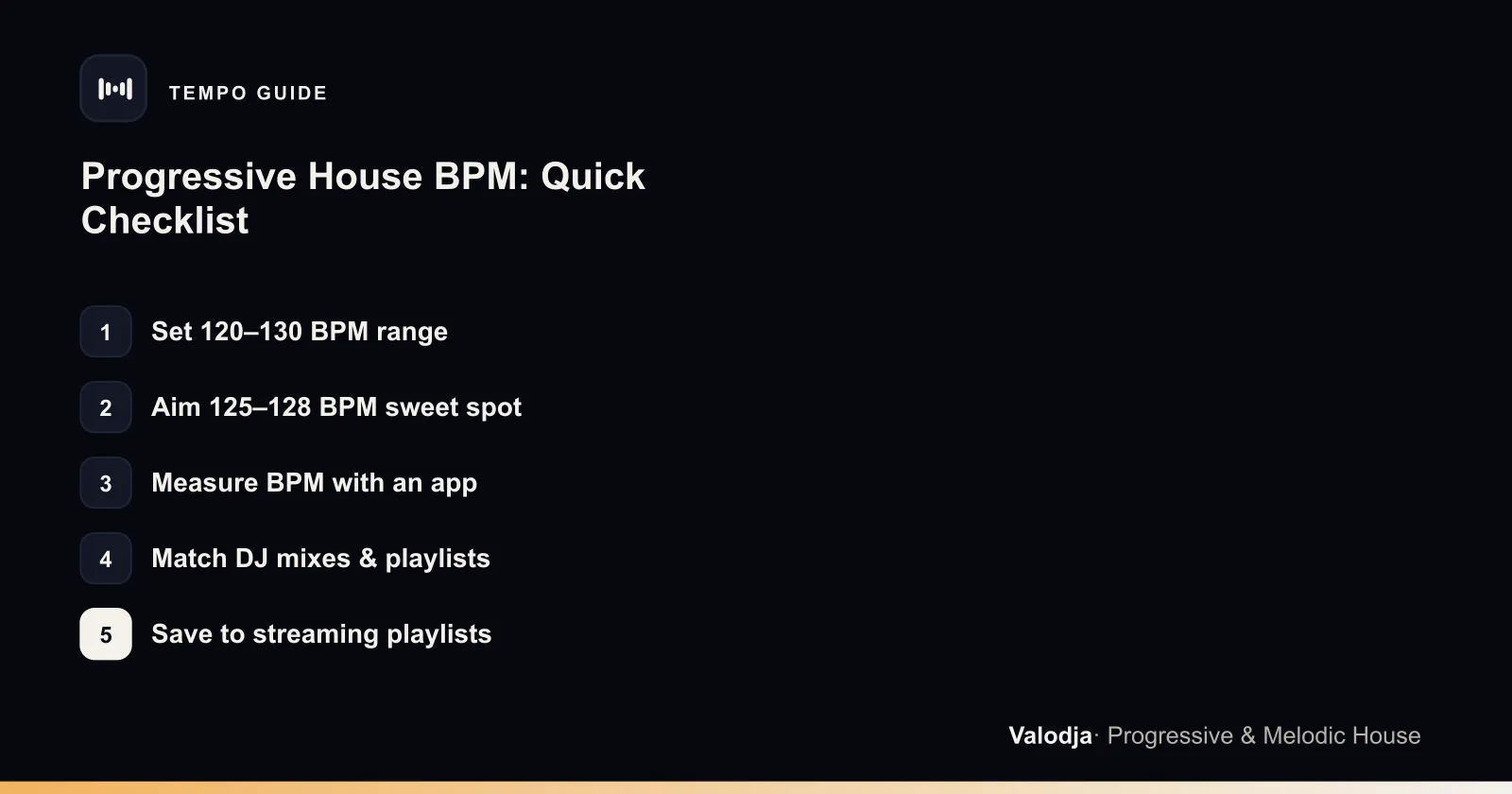
Tempo (BPM) sits most often between 122 and 126, with a steady four‑on‑the‑floor groove. The pacing feels smoother than a typical pop‑EDM drop because momentum comes from layering and subtraction. You’ll notice rolling hi‑hats, syncopated percussion, and basslines that lock with the kick without overwhelming the midrange where pads and chords live.
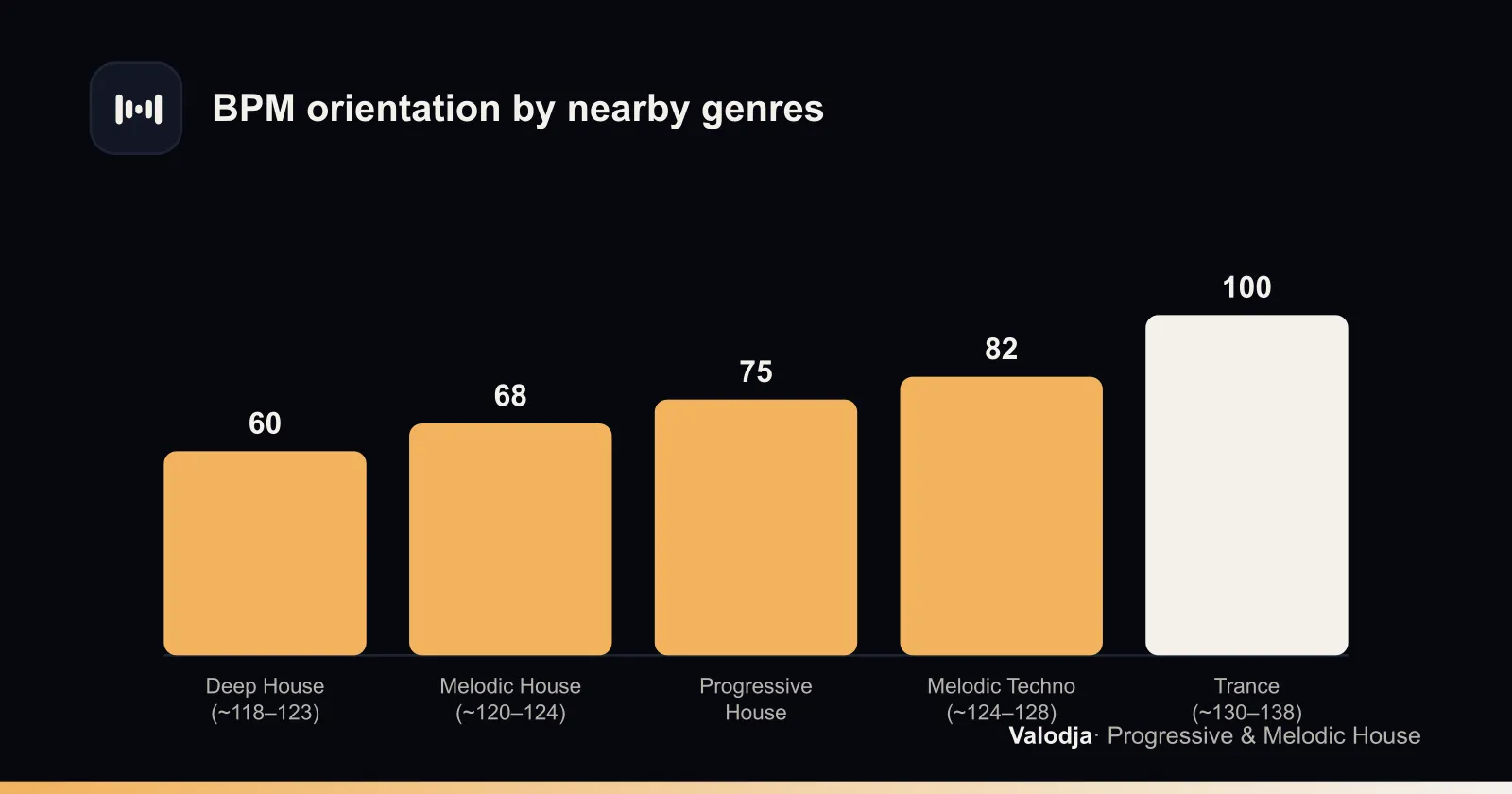
Quick orientation by BPM and feel:
| Style | Typical BPM | Groove feel |
|---|---|---|
| Deep house | 118–123 | Relaxed, soulful swing |
| Melodic house | 120–124 | Warm, songlike pulse |
| Progressive house | 122–126 | Patient, driving, layered |
| Melodic techno | 124–128 | Tense, mechanical drive |
| Trance | 130–138 | Uplifting, high‑energy push |
Song structure and arrangement: builds, drops and continuity
Arrangement is where progressive shines. Expect long intros, evolving builds, emotive breakdowns where drums thin out, and a return to the groove with a controlled “drop.” Rather than hard stop‑start turns, continuity is the goal—the track keeps flowing even at peaks.
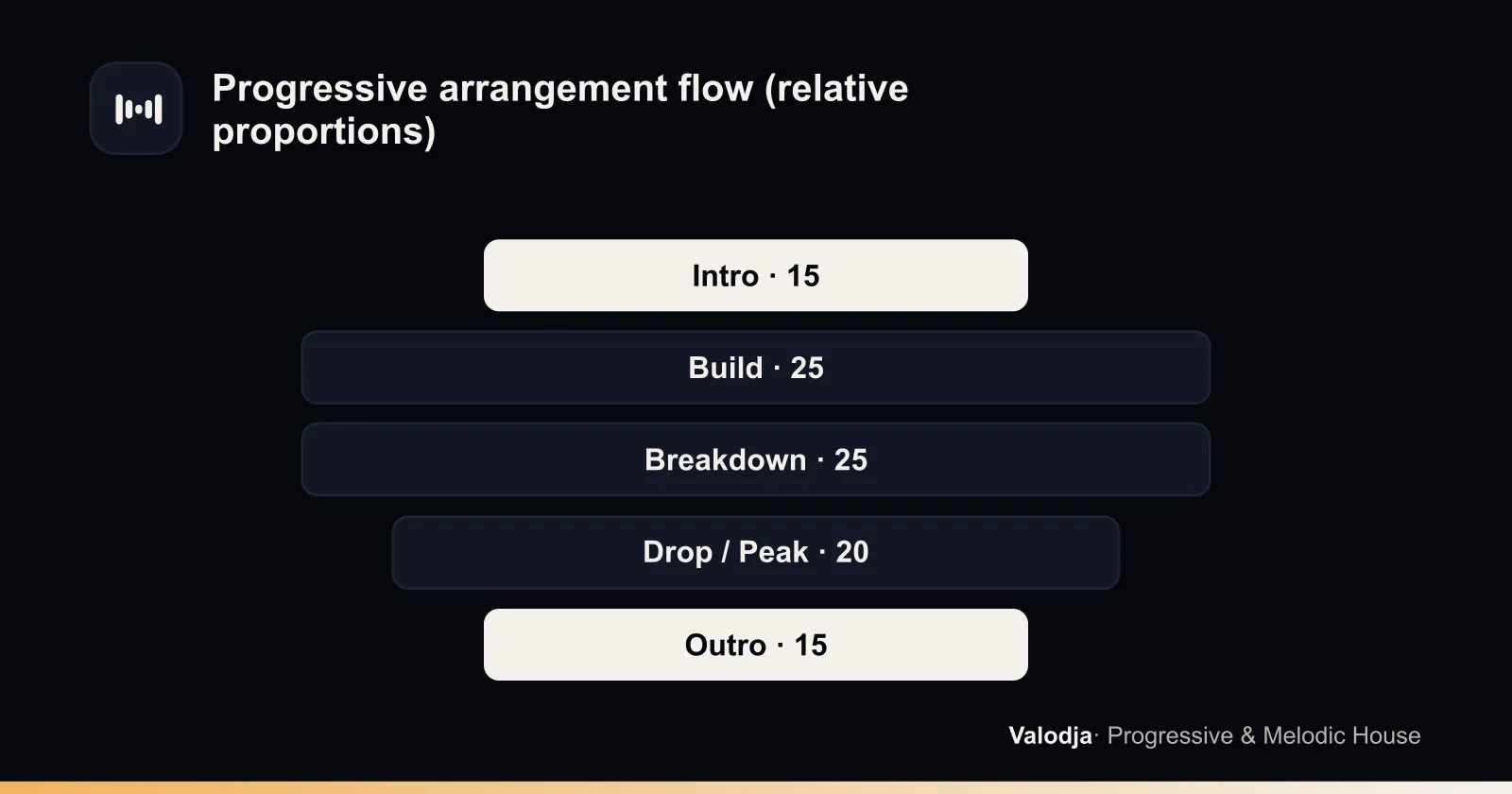
Structure cues you’ll hear:
- Intro: drums and a few motif hints for easy mixing.
- Build: new layers fade in; filters open; tension rises.
- Breakdown: drums recede; chords and pads swell; melody breathes.
- Drop/Peak: groove returns, often with added harmony or countermelodies.
- Outro: elements peel back, setting up the next mix.
Comparison of arrangement emphases:
| Element | Pop‑EDM Big‑Room | Progressive House | Melodic Techno |
|---|---|---|---|
| Intro length | Very short | Long, DJ‑friendly | Medium |
| Build style | Quick risers | Gradual layering | Tension via patterns |
| Breakdown | Brief | Expansive, chord‑led | Spacious but darker |
| Drop impact | Abrupt, maximal | Controlled, groovy | Punchy but moody |
| Continuity | Stop‑start | Seamless flow | Hypnotic loops |
Harmony and melody: chords, progression and emotional motion
Chords and melody carry emotion. Progressive house favors expressive chord progressions—often with suspended chords (sus2/sus4 flavors), octave runs that widen themes, and motifs that evolve over minutes. Pads keep harmony in the foreground without choking the mix. You’ll also hear modal colors and voice‑leading that give the music a gentle lift without saccharine sweetness. It’s not unusual to hear a classical music influence on progressive house in the sense of long‑form development and thematic variation over time.
Listener tip:
- If a track makes small harmonic changes every 16–32 bars, you’re likely in progressive territory.
- If a single motif gets reharmonized or texturally reframed, that’s the “progressive” in action.
Sound design and textures: pads, atmospheres and synths
In sound design, progressive house leans on wide pads, tasteful reverb tails, airy arpeggios, and warm synth layers that create an immersive atmosphere. A soft top‑end shimmer keeps the mix vivid without harshness. You may also hear field recordings or organic textures (rain, crowd murmur, foley hits) in the organic branch to deepen space.
What to listen for:
- Pads and reverb that bloom during breakdowns and tuck back into the groove.
- Arps that repeat but morph via filters and delay feedback.
- Subtle noise sweeps, risers, and reverse tails connecting sections.
Drums, bass and rhythm section
Drums: a steady 4/4 kick anchors the groove, with crisp claps/snares and evolving percussion. Hi‑hats often roll in 16ths with gentle accent shifts to avoid monotony. Bass: round and supportive, it outlines chord roots and propels the groove without crowding the mids. The rhythm section aims for propulsion beneath melodic content—movement without distraction.
Checklist of rhythm cues:
- 4/4 kick with restrained processing.
- Percussion that changes shape every 8–16 bars.
- Bass patterns tied to chord movement, often sidechained to the kick.
Common production techniques listeners can hear
You don’t need to make tracks to hear the tricks:
- Sidechain: the gentle “breathing” as pads and bass duck under the kick.
- Automation: filters, reverbs, and delays gradually open or close to shape builds and breakdowns.
- Filter moves: low‑pass sweeps that slowly reveal the full spectrum.
- Mixing choices: midrange space for chords; mono‑friendly low end; subtle stereo movement in pads.
How progressive house relates to nearby genres
Progressive house vs its neighbors—melodic techno, deep house, and trance—comes down to tone, structure, and intent. Melodic techno is drier and more machine‑forward; deep house is warmer and more vocal/soul‑leaning; trance is faster and peakier. Progressive sits between, prioritizing development and harmony over drama alone.
Progressive house vs melodic techno
Both can be melodic and hypnotic. The difference: melodic techno tends to lean on techno’s darker timbres and rigid patterns, while progressive house prefers songlike chord movements, rounder pads, and smoother transitions. Think “patient and open” versus “tense and mechanical.” For a longer breakdown, see the dedicated comparison article on this topic.
Progressive house vs deep house and vs trance
- Deep house compare: typically slower, groovier, and closer to soul and jazz harmony. Progressive is a bit brisker and more focused on evolving chord progressions and bigger breakdowns.
- Trance compare: shares emotional melody, but trance hits higher BPMs with more overt supersaw leads and dramatic uplifts. Progressive keeps peaks integrated into the groove and emphasizes continuity.
Summary table of traits:
| Trait | Progressive House | Melodic Techno | Deep House | Trance |
|---|---|---|---|---|
| BPM | 122–126 | 124–128 | 118–123 | 130–138 |
| Timbre | Warm pads, lush leads | Darker, industrial edge | Smooth, soulful | Bright, supersaw leads |
| Structure | Long builds, continuity | Hypnotic loops, tension | Verse/chorus or loop‑based | Peak‑driven, anthemic |
| Harmony | Evolving progressions | Sparse, modal riffs | Jazzy extensions | Big tonal lifts |
| Drop | Controlled return to groove | Punchy but moody | Understated | Big, euphoric |
Festival/‘big-room’ progressive vs underground/organic progressive
Two broad branches you’ll encounter:
- Festival progressive: brighter leads, bigger drum hits, dramatic breakdown‑to‑drop moments; tailored for large stages.
- Underground/organic progressive: subtler peaks, earthy textures, field recordings, and a slower‑burn arc.
Quick comparison matrix:
| Aspect | Festival Progressive | Underground/Organic Progressive |
|---|---|---|
| Energy curve | Pronounced peaks | Slow‑burn rise |
| Timbre | Bright, polished leads | Warm, textural pads |
| Arrangement | Shorter intros, bigger drops | Longer intros/outros, seamless transitions |
| Use case | Mainstage moments | Late‑night rooms, sunset sets |
Representative examples and listening guide
Below are often‑cited examples of progressive house (tracks and mixes) that illustrate different shades of the genre. I keep these nearby in my own DJ prep when I want to show the spectrum from classic to modern.
10 tracks and mixes to start with
Use this track list as a starter map; each entry notes what to listen for. It mixes classics, festival‑leaning moments, and underground textures.
| Type | Artist – Title | Why it helps you hear “progressive” |
|---|---|---|
| Track | Bedrock (John Digweed & Nick Muir) – Heaven Scent | Often‑cited classic: patient build, rolling groove, emotive pads |
| Track | Sasha – Xpander | Long‑form development with iconic chord swells; a touch between prog house and trance |
| Track | Pryda – Pjanoo (Eric Prydz) | Festival‑prog piano motif and a measured, triumphant rise |
| Track | Deadmau5 – Strobe | Slow, emotional ramp from ambient intro to locked groove |
| Track | Eric Prydz – Opus | Extended build that demonstrates tension through time |
| Track | Guy J – Lamur | Deep, hypnotic progression and elegant percussion |
| Track | Yotto – Walls | Warm, modern melodic progressive; rich pads and steady lift |
| Track | Lane 8 – Atlas | Songlike harmony with subtle, flowing transitions |
| Mix | Sasha & John Digweed – Essential Mix (often‑cited episode) | A reference for journey‑style programming across tempos |
| Mix | Hernan Cattaneo – Resident (mix series) | Masterclass in underground/organic progressive pacing |
Tip: save these into a folder for A/B listening. Notice how arrangement length and harmonic motion define the mood.
Where to hear progressive house now: playlists, mixes and platforms
- Spotify: search for progressive house, melodic house, and artist radios for names above. You’ll also find editorials and label playlists. The melodic-house-for-focus playlist embed appears near the top and again here for easy follow.
- Beatport & Traxsource: browse progressive house, melodic house, and melodic techno tags for fresh weekly releases.
- YouTube & SoundCloud: long DJ mixes and radio shows; use timestamps to jump between builds and breakdowns.
Downloads available on this page:
- Progressive House Listening Cheat Sheet (PDF)
- Progressive House Starter Playlist (XLSX)
How to listen: building a progressive house playlist
A great progressive set or playlist creates flow: a sense of direction without jolts. For listeners, curation is about matching tempo, mood, and harmonic color while leaving room for a few surprises.
A simple curation framework:
- Pick a tempo lane: 122–126 BPM keeps mixing and listening smooth.
- Choose a mood arc: warm and hopeful, moody and nocturnal, or open and euphoric.
- Sequence for motion: start with texture‑forward tracks, build to chord‑led peaks, land back on groove.
Starter playlist worksheet:
| Slot | BPM target | Mood tag | Key/Color | Track idea |
|---|---|---|---|---|
| 1 | 122 | Warm/intro | Neutral | Textural opener with long intro |
| 2 | 123 | Lift | Bright | First chord‑led theme enters |
| 3 | 124 | Focused | Cool | Groove‑heavy, keeps energy moving |
| 4 | 124 | Hopeful | Bright | First bigger breakdown/payoff |
| 5 | 125 | Peak | Open | Signature motif, but still smooth |
| 6 | 124 | Glide | Neutral | Transitional, fewer drums |
| 7 | 123 | Settle | Warm | Pad‑forward closer with long outro |
From my DJ sets, the most replayable playlists use tracks that share a pacing philosophy rather than identical sounds.
How progressive house makes people feel — a listening map
Progressive house aims for transportive focus: steady rhythm, evolving harmony, and a gentle sense of lift. Common listening scenes include:
- Late‑night driving: the groove steadies your attention without spikes (driving‑music done right).
- Sunset sessions: chords bloom as the light fades; breakdowns feel reflective rather than explosive.
- Focused listening: the gradual arc keeps you engaged without demanding every second.
Mood cues by arc:
- Opening: contemplative and spacious.
- Middle: determined, hopeful, subtly energetic.
- Peak: expansive and uplifting, never harsh.
- Close: grounded and calm, with lingering reverb tails and pads.
Common misconceptions and debates
- “Progressive house is just trance.” Overlap exists, but tempo ranges, synth choices, and arrangement shape differ; progressive is more groove‑anchored.
- “It’s all big‑room EDM.” Festival progressive is one branch; much of the genre is underground or organic in tone.
- “No vocals allowed.” Vocals appear, but they’re often textural or restrained to preserve flow.
- Ongoing debate: genre boundaries in the 2020s. Digital stores and labels file similar records under progressive house, melodic house, or melodic techno, depending on emphasis.
If you want a shorthand, remember: progressive equals development. The tools—tempo, timbre, and harmony—vary, but the long arc remains.
FAQ: quick answers to common questions
- What is progressive house music? It’s a subgenre of EDM built on gradual builds, smooth transitions, and evolving chord progressions, emphasizing atmosphere over short pop hooks.
- What is progressive house EDM? The phrase points to the same thing—edm progressive house is a long‑form, melodic branch within electronic dance music.
- Is progressive house EDM? Yes; progressive house EDM sits inside electronic dance music, though it often targets DJ mixes and listener journeys rather than radio edits.
- What are the characteristics of progressive house music? Long builds and breakdowns, evolving chord progressions, rich pads and atmospheres, a steady 4/4 groove, and patient arrangement choices.
- Progressive house vs melodic techno—what’s the difference? Melodic techno tends to darker, more mechanical timbres and tighter patterns; progressive house is smoother with more open, songlike chord movement.
- What’s the difference between progressive house and deep house? Deep house favors soulful harmony and relaxed grooves; progressive house aims for evolving structures and bigger, emotive breakdowns.
Conclusion — where to go next
You now have the progressive house music meaning, its origins, the progressive house music genre characteristics, and concrete examples to explore. Follow the embedded Spotify playlist and the author’s mix on this page for instant listening. For deeper context on differences, see our dedicated comparison of progressive house vs melodic techno by searching for it on the site. When you’re ready to build your own flow, download the PDF cheat sheet and the starter playlist XLSX, save a few favorites, and let the long arc carry you.
FAQ
- Can you explain what progressive house is?
- Progressive house is a subgenre of EDM where tracks evolve gradually through layered textures, chord progressions, and rhythmic builds, emphasizing atmosphere and melodic development over short pop structures.
- What’s the difference between progressive house and deep house?
- Deep house leans toward soulful vocals and jazzy harmonies with a laid‑back groove, while progressive house focuses on long builds, expansive breakdowns, and evolving chord progressions.
- What are examples of progressive house music?
- Often‑cited examples include tracks by Sasha, John Digweed (Bedrock), Eric Prydz (Pryda), Deadmau5, Guy J, Yotto, and mix series like Anjunadeep Edition and Hernan Cattaneo’s Resident.
- Which artists are progressive house?
- Artists often linked to progressive house include Sasha & John Digweed, Eric Prydz (and Pryda), Deadmau5, Guy J, Hernan Cattaneo, Yotto, Lane 8, and Tinlicker—spanning underground and festival interpretations.
- Is progressive house EDM?
- Yes. Progressive house is commonly understood as a subgenre of EDM, though it often favors long‑form listening and DJ‑mix continuity over radio‑single formats.